A Young Man and a Chance Discovery
New York City, 1962. Howard Lotsof is 19 years old, a film student, and a heroin addict. Like many young people of his era experimenting with the countercultural underground, he has tried a variety of psychedelic compounds. When a friend offers him a substance called ibogaine — synthesized from the African iboga plant — Lotsof agrees to try it.
What follows is one of the most remarkable stories in the history of medicine. After a 36-hour experience of intense visual imagery, emotional processing, and something he would later describe as a profound encounter with his own life history, Lotsof emerges — and discovers that he has no desire for heroin. No cravings. No withdrawal. The physical dependence that had gripped him is simply gone.
"I woke up and realized I wasn't thinking about heroin. I couldn't remember the last time that had happened." — Howard Lotsof
Expanding the Discovery
Lotsof, a naturally curious and scientifically minded young man, did not keep his discovery to himself. He shared ibogaine with seven other heroin-dependent friends, several of whom reported the same dramatic reduction or cessation of withdrawal symptoms and cravings.
This was not placebo. Something pharmacological was occurring — something that no other substance, conventional or otherwise, had ever achieved: the interruption of opioid addiction with a single dose. Ibogaine operates unlike any classical psychedelic. It activates all three opiate receptors, the NMDA receptor, nicotinic acetylcholine receptors, and the serotonin and dopamine transporter systems. Uniquely, it also stimulates three critical neurotrophic proteins — BDNF, GDNF, and NGF — promoting survival, growth, and maintenance of the central nervous system and modulating the neuroplasticity that underlies long-term addiction recovery.
A Life Devoted to Ibogaine
In the aftermath of his discovery Lotsof was convicted — in 1968 — on three counts of selling LSD, becoming the first American sent to prison for LSD offences. He served eighteen months. It only deepened his commitment to the cause of those failed by a criminalising drug policy.
In 1983, following recovery from heroin addiction, Lotsof established the Nora Wiener Foundation, named after his beloved grandmother, a Holocaust survivor. Though it failed to secure development funding, it became a vehicle for information collection and dissemination on ibogaine. In 1985, he was granted his first patent: Rapid method for interrupting the narcotic addiction syndrome. Four further patents — for cocaine, alcohol, nicotine, and poly-addiction — followed between 1985 and 1992.
Unable to conduct clinical research in the United States — where ibogaine had been reclassified as Schedule I in 1970 — Lotsof moved his work to the Netherlands, where ibogaine remained legal. He established the first ibogaine treatment protocols, documented outcomes systematically, and collaborated with researchers around the world to publish the first systematic evidence of ibogaine's effects on addiction. In 1993, after years of advocacy, the FDA approved the first ibogaine clinical trial in the United States.
Norma Lotsof: The Architect Behind the Movement
Alongside Howard at every step was his wife, Norma Lotsof. Howard and Norma were married in 1964, and both graduated from NYU Film School in 1976. Norma was the chief administrator of the Group — as their close collaborators called themselves — and her wisdom was indispensable. Time and again, her shrewd judgment helped the movement navigate bureaucratic hostility, internal tensions, and the uncharted territory of building a treatment paradigm from scratch.
As Boaz Wachtel, who worked alongside them both, has written: "Norma was, and still is, an instrumental figure in the ibogaine movement, providing wisdom and shrewd advice to the Group and to the people around it." That role — strategic, stabilising, essential — is one that rarely receives adequate recognition in histories focused on scientific breakthroughs and medical firsts. Norma's contribution was the connective tissue that held the ibogaine movement together through its most difficult decades.
Support Norma Lotsof — one of the unsung heroes of the ibogaine movement and a tireless partner in Howard's life work. Please consider contributing to her GoFundMe campaign.
Support Norma's GoFundMeBob Sisko — Robert Rand: The Man Who Made It Possible
A third key figure in ibogaine's early history is rarely mentioned outside the inner circle: Bob Sisko, also known as Robert Rand. A PR specialist who became a paralegal — and, in practice, something of a "para-illegal," as Wachtel describes him — Sisko began working as a PR consultant for the Lotsofs in 1985. That year, the three of them flew together to Gabon, met President Omar Bongo, and secured the first supplies of high-quality iboga root bark for processing in Belgium.
Sisko had himself been heavily addicted to cocaine, nicotine, and alcohol when Wachtel first encountered him in 1986. The transformation Sisko underwent after receiving ibogaine treatment administered by Lotsof was staggering. When Wachtel next visited him, the man he found was clean from all hard substances — and had, as a remarkable spiritual side effect of his ibogaine journey, become a devout observant Jew. "I thought to myself," Wachtel recalls, "how a onetime 'trip' could transform so many aspects of Bob's drug consumption patterns in such a short time? That was truly remarkable."
Sisko went on to become one of the frontline treatment providers of the early movement, travelling to the Netherlands solo in 1990 to treat Nico Adriaans, founder of the Dutch Junkiebond — a treatment that sparked a grassroots wave of ibogaine use across Rotterdam. It was Sisko who also produced the original Nine Case Histories reports that provided NIDA with enough evidence to launch its $5 million pre-clinical research programme in 1991.
The Meeting That Shaped History: Lotsof and Wachtel
In the late 1980s, Israeli researcher and activist Boaz Wachtel — a former combat medic and assistant army attaché at the Israeli Embassy in Washington DC — joined the Group as its fourth member. He and Sisko formed ICASH (International Coalition for Addicts Self Help), operating as an underground treatment team across Amsterdam squats, Rotterdam apartments, and one-star hotels.
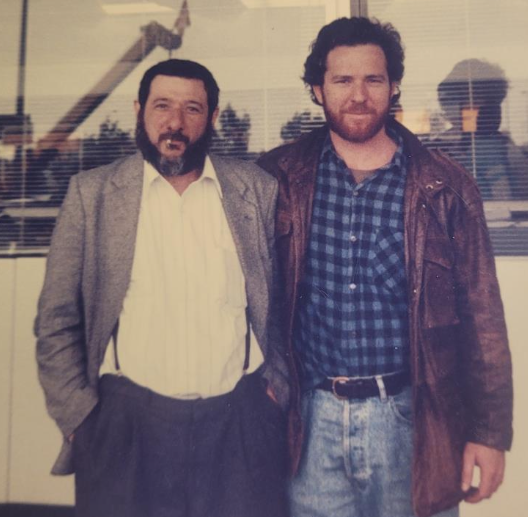
Wachtel's cooperation with Lotsof eventually resulted, in 2003, in the publication of the first Manual for Ibogaine Therapy: Screening, Safety, Monitoring & Aftercare — the definitive clinical guide to safe ibogaine administration that treatment centres around the world still reference today. Their collaboration exemplified what ibogaine research has always required: visionary individuals willing to work across disciplines, cultures, and institutional barriers to advance a treatment the mainstream medical establishment was too cautious — or too invested in existing paradigms — to embrace.
Lotsof's Legacy
Howard Lotsof died in 2010 at the age of 66, having dedicated four decades of his life to ibogaine. He did not live to see the Stanford study, or Texas's $50 million investment, or the growing movement of veterans and families advocating for ibogaine access in the United States, Canada, and Israel. But everything that is happening now traces a direct line back to a young man in New York who woke up one morning, unexpectedly free, and decided to tell the world.
At the Ibogaine Foundation of Israel, we honour Howard Lotsof's legacy — and those of Norma, Sisko, Wachtel, and all the early pioneers — every day. The healing we advocate for: of soldiers, survivors, and all those living with the weight of trauma, begins with their gift.